You don’t need a college degree or a state license to start working as a dental assistant in California. Many people go from no experience to working in a dental office in a few months. What you do need is the right training and a handful of certificates that employers, and the Dental Board of California, expect you to have.
This guide walks through each step: what you need to start, which certificates matter, how to become a Registered Dental Assistant (RDA) later, and how long and how much it all takes.
Do you need a license to be a dental assistant in California?
No. California has two levels of dental assisting:
- Dental assistant (unlicensed): You can be hired with certifications and perform basic supportive duties under a dentist’s supervision.
- Registered Dental Assistant (RDA): A state license from the Dental Board of California. RDAs can perform more duties, and the license usually leads to higher pay and more job options.
Even without a license, California law sets a few requirements for dental assistants. Upon your first day of employment, you need:
- A board-approved 8-hour infection control course
- A board-approved two-hour California Dental Practice Act course
- Current Basic Life Support (BLS) certification
And before you take any X-rays, you need a board-approved radiation safety course.
Most offices prefer to hire assistants who already have these, which is why completing them before you apply gives you a real advantage.
Step 1: Get trained
There are three common ways to learn dental assisting in California:
- On-the-job training: Some offices hire beginners and train them. These jobs can be hard to find without any background.
- A short training program: Hands-on programs teach the skills offices look for and include the key certificates. This is the fastest way to become job-ready.
- A board-approved RDA program: Longer programs, often around nine months, that qualify you to apply for the RDA exam when you finish.
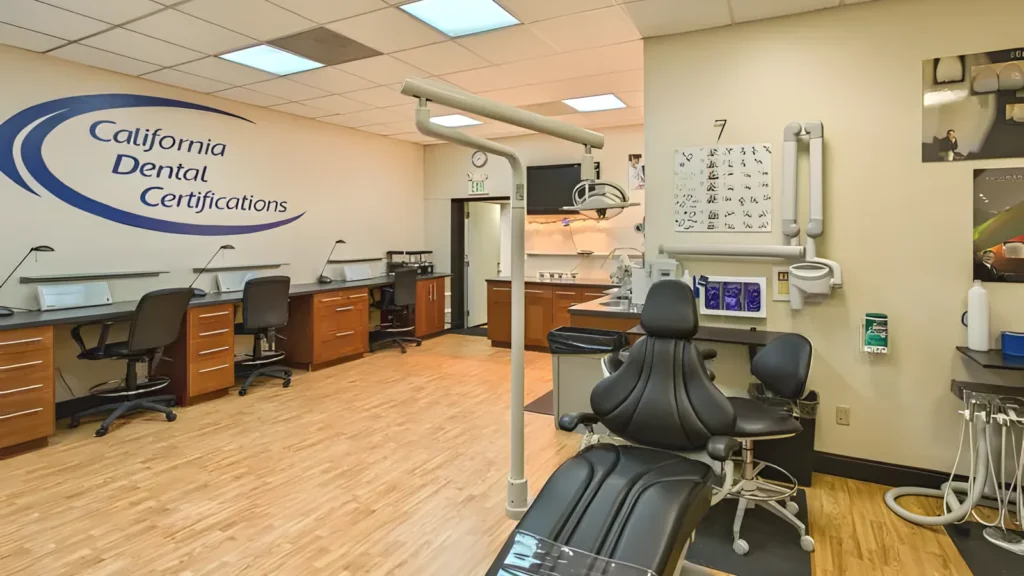
At California Dental Certifications in San Diego, our Dental Assisting Training program runs on Saturdays and Sundays, 9am to 5pm, for four weeks. No previous dental experience is required. You’ll practice dental anatomy, charting, X-ray processing and mounting, sterilization, instrument passing, alginate impressions, stone pours and prophy polishing.
Step 2: Earn the certifications employers look for
These are the certificates that matter most for California dental assistants. They’re also the ones you’ll need later for your RDA application:
- Radiation safety (X-ray): Required.
- 8-hour infection control: Required.
- California Dental Practice Act: Required.
- Basic Life Support (CPR): Required.
- Coronal polish: Required.
- Pit and fissure sealants: Required for the RDA license.
Our Dental Assisting Training program includes the X-ray, coronal polish, 8-hour infection control, Dental Practice Act and AHA CPR certificates. That leaves pit and fissure sealants as the last course you’ll need before applying for your RDA, after at least 15 months and a minimum of 1,280 hours of work experience.
Step 3: Start working
With your training and certificates done, you’re ready to apply to dental offices as a dental assistant. Have your certificates, BLS card and resume ready. Our program includes a resume, an introduction letter and a thank-you letter to help with your search.
Your work experience counts toward your RDA license, so track your start date and hours from day one.
Step 4: Become a Registered Dental Assistant (RDA)
The RDA license is the next step for most dental assistants. The Dental Board of California offers several ways to qualify. The two most common are:
- Graduate from a board-approved RDA program, which includes the required courses and 9 months of school.
- Work experience: At least 15 months and a minimum of 1,280 hours working as a dental assistant, plus the required courses below.
If you take the work experience route, you’ll need these board-approved courses. Each has to be recent enough when the Board receives your application:
| Course | Minimum length | Must be completed within |
|---|---|---|
| Radiation safety | 32 hours | 10 years |
| Coronal polishing | 12 hours | 5 years |
| Pit and fissure sealants | 16 hours | 5 years |
| Infection control | 8 hours | 2 years |
| California Dental Practice Act | 2 hours | 2 years |
| Basic Life Support | Current certification | Must be current |
Then you’ll:
- Submit your application to the Dental Board of California with the $120 application fee and your course certificates.
- Complete fingerprinting for a background check.
- Pass the RDA Combined Written and Law and Ethics Examination, a computer-based test given by PSI.
Already working as a dental assistant? Our RDA Prep Package bundles the required courses in one place, and our RDA application guide walks through the paperwork step by step.
How long does it take?
- To start working: About one month with the California Dental Assisting Course through CDC.
- To become an RDA through work experience: At least 15 months of work after you’re hired, plus time for the Board to process your application and for you to schedule the exam.
- Through a board-approved RDA program: The length of the program, often around nine months, plus application and exam time.
How much does it cost?
Our Dental Assisting Training program is $2,500. Several options can lower or spread out the cost:
- MyCAA for eligible military spouses
- WIOA funding for eligible job seekers
- Pay over time with Klarna or Afterpay at checkout
For the RDA license, plan for the $120 Dental Board application fee, plus the exam fee and the cost of fingerprinting.
Frequently asked questions
Can I work as a dental assistant in California without a certificate?
No. You must complete infection control, the Dental Practice Act course and BLS, and you need radiation safety before taking X-rays. Offices prefer candidates who already have them.
What’s the difference between a dental assistant and an RDA?
A dental assistant performs basic supportive duties. An RDA holds a license from the Dental Board of California and can perform additional duties, such as applying sealants.
How many hours of work do I need for the RDA?
At least 15 months and a minimum of 1,280 hours of work experience as a dental assistant, if you qualify through work experience.
Do I need dental experience to start training?
No. Our Dental Assisting Training program is designed for beginners, and no previous dental experience is required.
Where is the training held?
Our classes are held at 1059 First Ave, San Diego, CA 92101.
Requirements are based on Dental Board of California guidelines as of November 2026. Check the Dental Board of California for the latest information.
